
Rare Earth Elements: The Backbone of Modern Technology
The global conversation about technology, sustainability, and innovation often overlooks a critical foundation: Rare Earth Elements.
These materials, which support devices, systems, and infrastructure, define modern life, playing a vital role from smartphones to renewable energy solutions.
Despite the name, they are not necessarily rare in nature; however, they are difficult to extract, process, and recycle. This complexity gives them enormous strategic, economic, and environmental importance in today’s interconnected world.
Understanding how these elements shape technological progress and energy transitions helps reveal who controls innovation, how global influence is shifting, and what the true cost of sustainability really is.
The Role of Rare Earth Elements in Technology
Rare earth Elements play a central role in nearly every advanced technology we rely on today. Their importance is tied to unique magnetic, optical, and electronic properties that enable greater performance in smaller sizes and with higher energy efficiency.
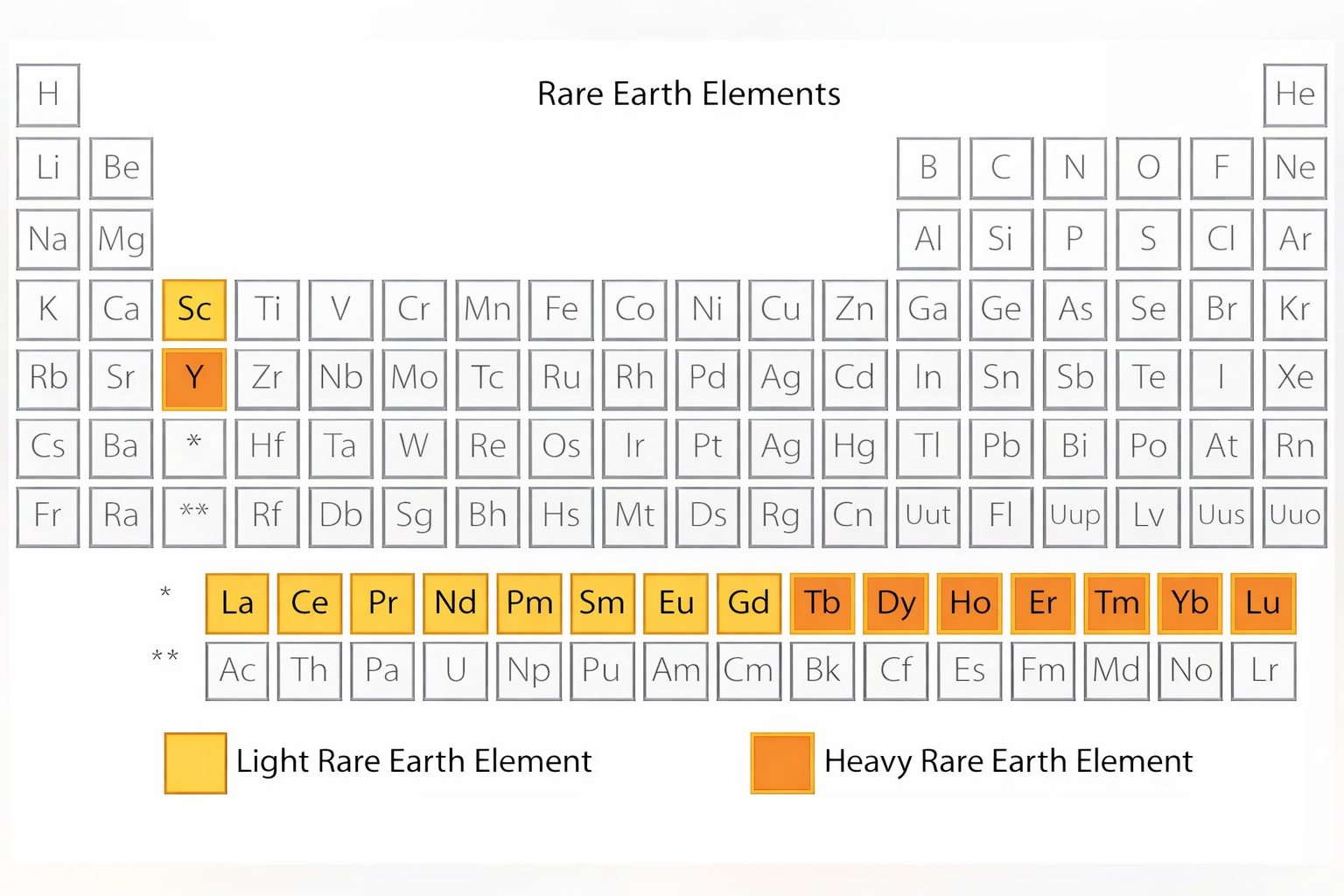
Rare Earth Elements are typically divided into light rare earth elements (LREEs) and heavy rare earth elements (HREEs) based on their atomic numbers and chemical properties. LREEs, such as lanthanum, cerium, and neodymium, are more abundant and commonly used in electronics, magnets, and batteries, while HREEs, including terbium, dysprosium, and lutetium, are scarcer and often critical for high-performance applications like advanced magnets, aerospace components, and specialized optical devices.
These elements form a group of 17 chemically similar metals that enable miniaturization, efficiency, and durability in electronic components.
Most of them belong to the group known as the Lanthanides (Atomic numbers 57–71). In addition to the lanthanides, there are two elements classified as Additional Rare Earth Elements due to their similar chemical properties and their occurrence in associated mineral deposits: Scandium (Sc) and Yttrium (Y). Although they are not part of the lanthanide series, they perform equally significant technological functions.
Where Rare Earth Minerals Make a Difference
Rare Earth value lies in their ability to enhance performance in ways no other materials can match. One example is rare earth magnets, especially neodymium-based magnets, which are among the strongest permanent magnets ever developed.
They allow manufacturers to create smaller, lighter, and more efficient components for electric motors, speakers, hard drives, and countless other devices. Without these magnets, many modern technologies would be bulkier, less efficient, and far more limited in capability.
But the role of rare earth elements extends far beyond consumer electronics. They are essential to the global transition toward cleaner and more sustainable energy solutions.
Solar panels, high-efficiency lighting, and advanced battery technologies also rely on these minerals to achieve the reliability and performance required for large-scale adoption. Wind turbines depend on rare earth magnets to generate electricity with maximum efficiency. As countries move toward ambitious climate goals, demand for rare earth elements continues to grow.
The automotive sector provides another compelling example. Electric vehicles depend on compact and powerful motors, and rare earth magnets make this possible. By integrating high-performance magnetic materials into electric drivetrains, manufacturers achieve greater torque, improved acceleration, and superior energy efficiency. The result is longer driving ranges and reduced energy consumption—critical factors for accelerating global adoption of electric mobility. As demand for electrified transportation increases, so does the strategic importance of rare earth elements in global supply chains.
In the medical field, these elements enable life-saving technologies and improved diagnostic precision. MRI machines, laser surgical tools, and advanced imaging systems rely on rare earth components to operate accurately.
Their ability to produce strong magnetic fields, sharp optical emissions, and stable chemical reactions makes them ideal for applications where precision and reliability are essential. Without these materials, many medical advancements we now take for granted simply would not exist.
Defense and aerospace sectors also depend heavily on rare earth elements. Jet engines, missile guidance systems, satellite communications, and advanced radar technologies incorporate these minerals to achieve the performance and durability required in demanding environments.
The strategic importance of rare earth elements has led many countries to prioritize strengthening stable and diversified supply chains, recognizing that technological leadership depends on consistent access to these resources.
Rare Earth Mining and the Price of Green Energy
Although green energy promises a cleaner future, its foundations are deeply tied to resource extraction. Rare earth mining is a complex and often controversial process, involving environmental risks and geopolitical tensions.
The extraction and refining of rare earth minerals require intensive chemical processing, generating waste that can contaminate soil and water if not properly managed. This has led many countries to limit domestic production, concentrating supply chains in a few regions of the world.
As demand for electric vehicles, wind power, and energy storage grows, pressure on these supply chains increases. The true price of green energy must include responsible sourcing, stricter environmental standards, and transparent global cooperation. Without these measures, the promise of sustainability risks being undermined by hidden ecological costs.
The Challenge of Recycling Rare Earth Elements
Recycling rare earth elements remains one of the greatest challenges in materials science. Unlike aluminum or steel, these elements are used in extremely small quantities and are often embedded within complex products.
Separating rare earth metals from discarded electronics requires advanced technology and significant investment. Currently, recycling rates remain low, largely because extracting new materials is often cheaper than recovering them from waste.
However, progress is underway. Scientists are developing new chemical and biological processes that could make recycling more efficient and economically viable. Improving the reuse and recovery of rare earth minerals will be essential to reducing environmental harm, securing long-term supply, and building a truly circular economy.
The Discovery of Rare Earths: How It All Began
The history of rare earth elements begins in the late 18th century, when Swedish chemist Carl Axel Arrhenius discovered an unusual mineral in the village of Ytterby. This mineral, later called ytterbite, contained several previously unknown elements that would form the foundation of the rare earth group. Sweden played a pioneering role in the early study and isolation of these elements.
Throughout the 19th century, scientists gradually isolated additional elements, including cerium, lanthanum, and neodymium. Each discovery advanced chemistry and materials science, but their similar properties made separation difficult, giving them a reputation for complexity and mystery. During this period, countries such as Germany and France also contributed to early research and extraction techniques.
In the early 20th century, rare earth elements began to find practical industrial applications, from early lighting technologies to magnets and catalysts. Mining operations expanded in countries such as India and the United States, which became significant producers during the mid-20th century.
Today, China dominates global rare earth production, supplying more than 70 percent of worldwide demand. Other countries, including the United States, Australia, and Brazil, are investing in new mining and refining technologies to diversify supply chains and reduce dependence on a single source, underscoring the strategic importance of these materials in modern technology and clean energy.
Will Rare Earth Elements Define Our Future?
Rare earth elements are more than industrial materials; they reflect how deeply our technological ambitions are intertwined with environmental responsibility. They drive innovation, enable clean energy, and sustain the digital systems we depend on every day.
At the same time, they challenge us to rethink how we mine, consume, and recycle the resources that shape our world. The future will not be defined solely by new inventions, but by the choices we make regarding sustainability, ethics, and global cooperation.
Recognizing the value of these elements is not only a technical matter, it’s also a human one. The path forward requires balance, awareness, and a collective commitment to progress that truly endures.
Image Source : www.sciencenotes.org